The NGL Championship Structure
The National Gymnastics League (NGL) is designed to recognise excellence at scale. Across the season, gymnasts compete within age categories, training-hour bands, levels and apparatus, across thirteen regions. This structure intentionally produces a large number of National Champions, reflecting the breadth of participation and achievement within the league. By the end of each season, there may be several thousand gymnasts who hold the title of National Champion within a specific category. This is not an unintended outcome, but a core feature of the NGL, ensuring that success is recognised wherever it is earned.
Because of this scale, it is neither practical nor necessary to bring every National Champion together into a single live National Final. National Champion titles within sub-categories are confirmed through the league’s standardised scoring, consistent judging and national ranking system, and these titles are final regardless of whether a gymnast attends a live finals event. Each National Champion’s achievement is therefore valid, recognised and recorded within the NGL system.
However, while this model successfully recognises achievement at scale, it presents a practical challenge when designing a live national event. Inviting all National Champions, or even all apparatus champions, would result in an event of unmanageable size. In addition, requiring gymnasts to travel to compete on a single apparatus does not align with the NGL’s ethos of providing a meaningful and rewarding competitive experience. The live National Final must therefore balance inclusivity with practicality, while ensuring that attendance is worthwhile for gymnasts, coaches and families.
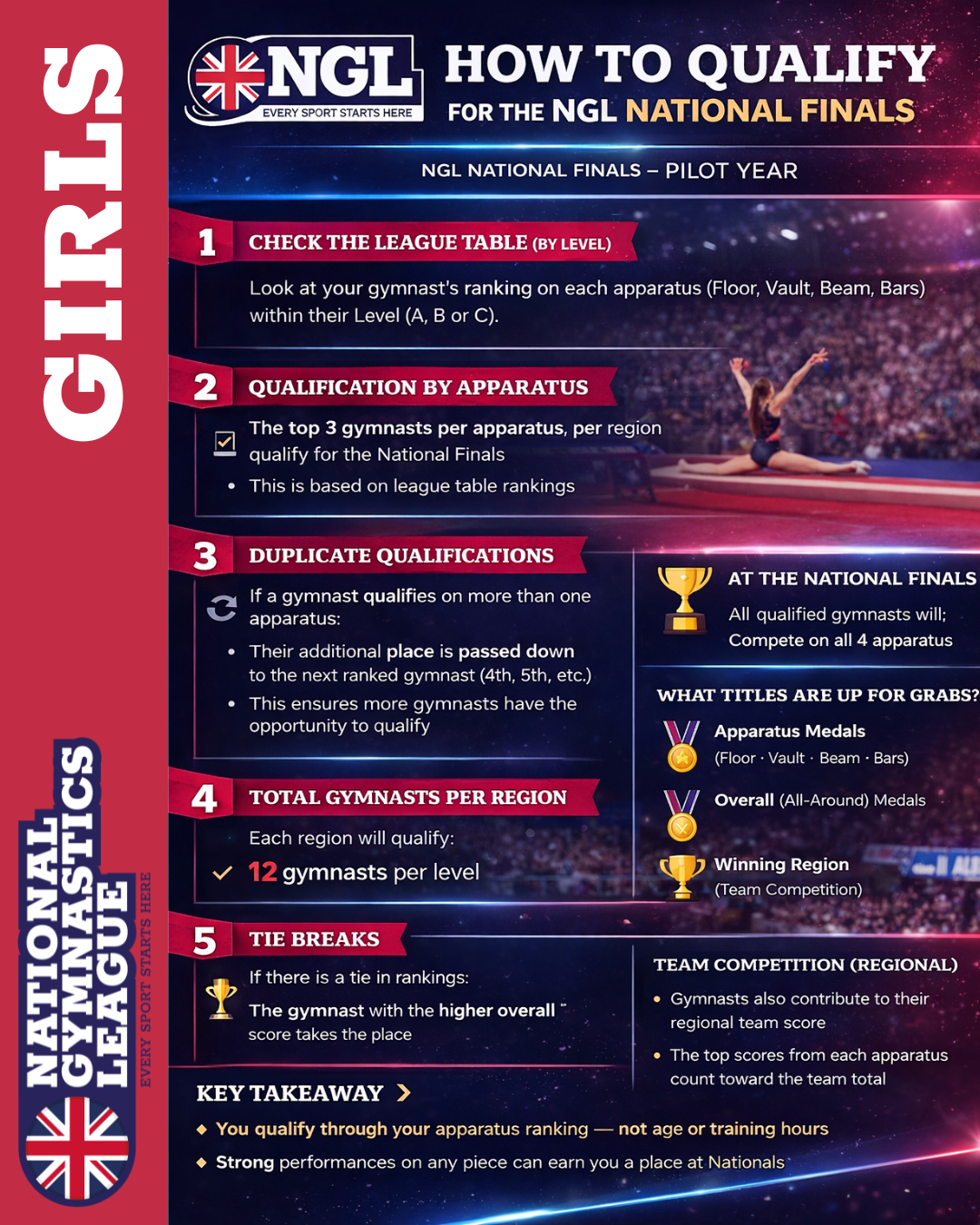
To achieve this, the NGL narrows progression to a single standout gymnast per category within each region. Categories are defined by age group, level and training-hour band. For each category, the selected gymnast is the highest all-around scorer across the season within that region, regardless of apparatus specialism.
These gymnasts represent the strongest overall performances within their category and become Regional Champions.
The Proposal for a National Finals
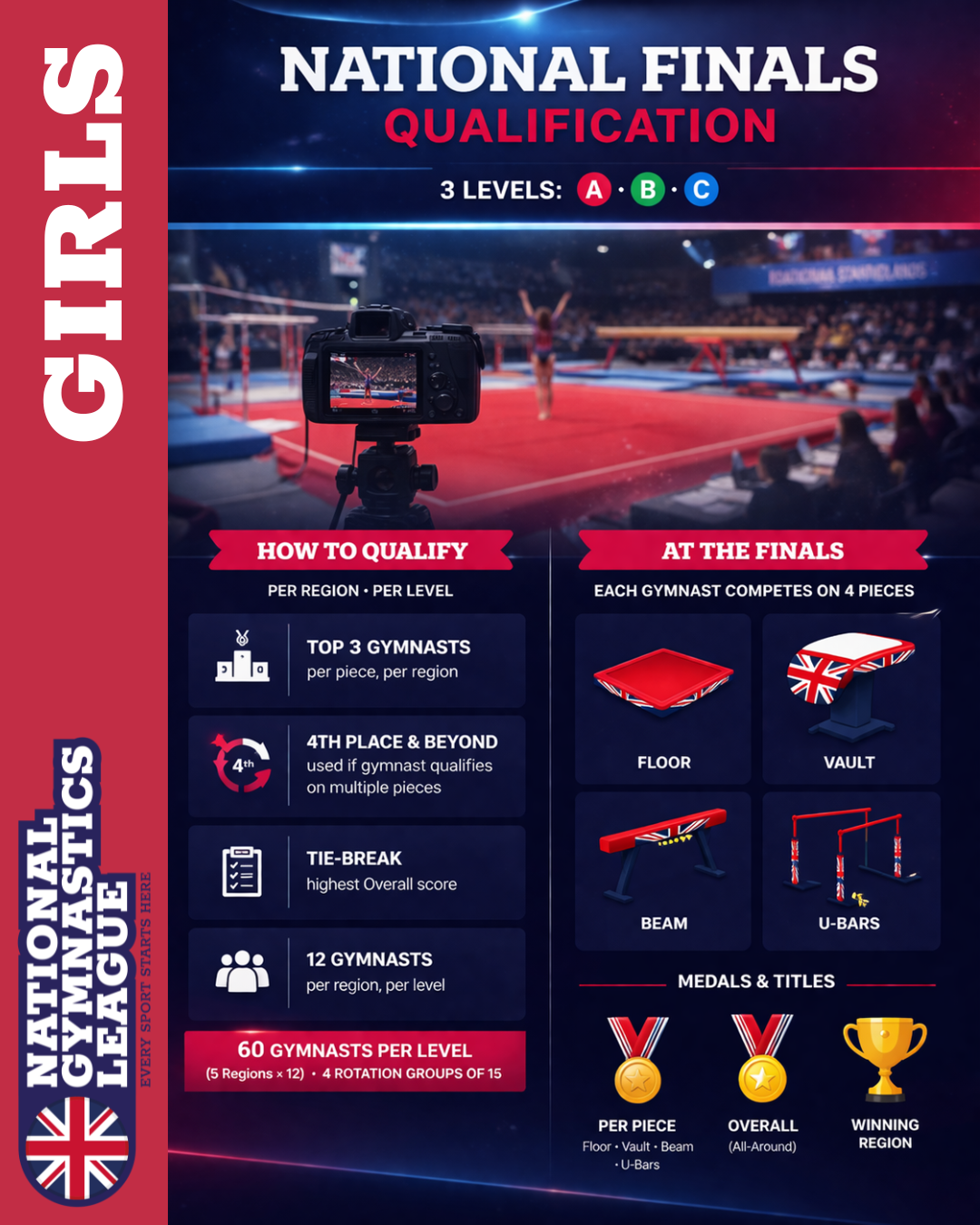
Regional Champions progress to the National Gymnastics League National Finals. To ensure a high-quality and manageable competition environment, it is proposed that the National Finals are delivered as three separate events: Level A, Level B and Level C.
Within each Level Final, gymnasts compete within their specific age group and training-hour category. With thirteen regions represented in each category, this results in thirteen gymnasts competing per category. Across the eight categories within each level, each National Final includes a maximum of one hundred and four gymnasts.
At the National Finals, all gymnasts compete across all apparatus relevant to their discipline, ensuring a complete and meaningful competitive experience. This format reflects the NGL’s commitment to fairness, athlete experience and competitive integrity, ensuring that gymnasts attend to compete fully rather than for a single piece.
Each National Final determines the National All-Around Champion within every category, alongside apparatus rankings within the competition. These titles sit at the pinnacle of the league’s competitive pathway, complementing the many National Champion titles earned throughout the season. One does not replace the other; they represent different stages of achievement within a unified system.
Following the National Finals, it is proposed that the NGL hosts National Champions Awards Ceremonies within each region. These events provide an opportunity for all National Champions from that region to be formally recognised and celebrated in front of their peers, clubs and families. Medals, trophies and certificates are presented in a celebratory, inclusive environment, without the pressure of live competition. Importantly, the location or format of the presentation does not affect the status of the title. Every gymnast recognised at these events is a National Champion by merit of their performance within the league.
This structure allows the NGL to remain inclusive, scalable and fair, while delivering a prestigious and meaningful live national final. It ensures that achievement is recognised at every level, that competition remains logistically realistic, and that the league culminates in a clear and exciting championship event that reflects the very best of the sport